

Biodiversity you can taste: how traditional ingredients are reshaping functional nutrition
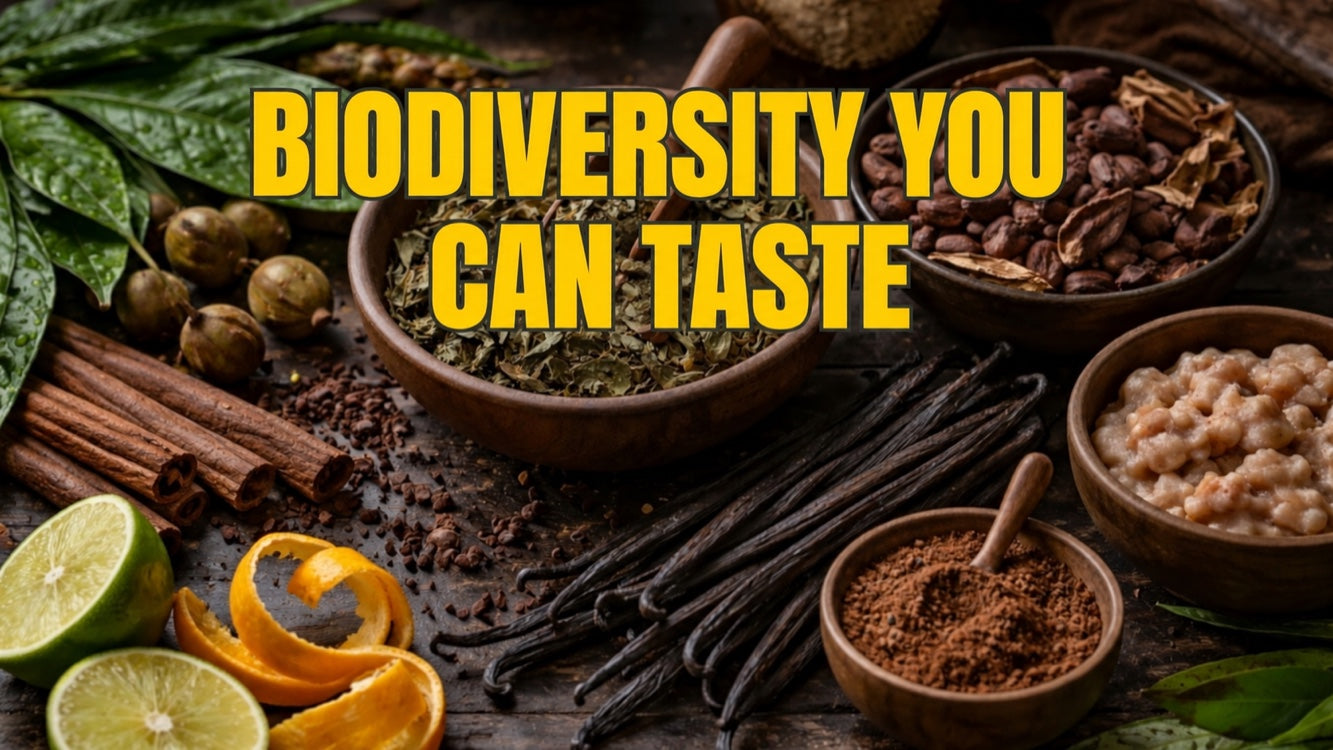
Key points at a glance:
- Real functional nutrition does not begin only in a laboratory: It often begins with biodiverse cultivation, traditional recipes and complex plant profiles.
- Biodiversity is not only an environmental issue: It also influences flavor, aroma and plant compounds—and therefore the quality of what we eat and drink every day.
- Guayusa is more than caffeine: In Kichwa tradition, it represents a morning ritual, clarity, connection and ancestral knowledge.
- Ishpingo is more than a cinnamon substitute: This Amazonian spice shows how much sensory and phytochemical diversity can be found in ingredients that are nearly forgotten.
- GUYA takes a systems-based approach to ingredients: A whole chakra network with more than 20 products—not just one plant—supports biodiversity and livelihoods.
Contents
- Introduction: Why modern functional nutrition often thinks too narrowly
- How biodiversity influences flavor and the world of nutrients
- Guayusa: The ingredient with the richest story
- Ishpingo: The almost-forgotten Amazonian answer to cinnamon
- What modern functional nutrition can learn from traditional ingredients
- Why GUYA does more than talk about this—it puts the idea into practice
- Frequently asked questions (FAQ)
- Sources and references
1. Introduction: Why modern functional nutrition often thinks too narrowly
Today, discussions of functional nutrition often revolve around isolated active compounds, capsules, powders, doses and quick effects. That is understandable. The modern market tends to think in clearly measurable parts: caffeine for alertness, electrolytes for performance, adaptogens for balance, polyphenols for cell protection.
But this often makes the picture too narrow. Whole foods do not act through just one compound. They act as a matrix of flavor, aroma, secondary plant compounds, origin, preparation and cultural context. That is why biodiversity, for us, is not only about conservation; it is also a nutrition issue.
If you want to understand why this perspective matters so much at GUYA, read our article Why biodiversity begins in your cup. It explains why biodiversity does not begin somewhere far away, but right in everyday life.
For us, the more interesting question is not only: Which compound has an effect? But: What ecosystem does an ingredient come from, what story does it carry, and what does its full complexity bring with it?
2. How biodiversity influences flavor and the world of nutrients
The research is clearer on this point than many people think. The WHO describes biodiversity as a foundation for healthy and sustainable food systems. According to the WHO, it directly influences food availability and nutritional value, including through the diversity of micronutrients and plant compounds. At the same time, research on dietary diversity indicates that a varied diet is associated particularly with better micronutrient adequacy.
That sounds technical, but in everyday life it is simple: Greater plant diversity usually means a wider range of sensory experiences and bioactive compounds. Flavor, aroma, bitterness, freshness, warmth, floral notes and astringent depth do not come from nowhere. They express the chemical and biological diversity of a plant.
That is why biodiversity matters not only for soil, water and climate. It is also relevant to how interesting, complex and functional foods can be. Monoculture standardizes. Biodiversity differentiates.
🧠 A common mistake in functional-food concepts
- They look for the most powerful single compound.
- They underestimate how whole ingredients work together.
- They ignore origin, cultivation and cultural knowledge.
- They confuse standardization with quality.
In the Amazon, we see the opposite. Ingredients do not arise in a vacuum, but in living systems such as the Kichwa chakra: forest gardens where plants are not separated, but considered in relation to one another.
| System | What is prioritized | Typical result |
|---|---|---|
| Monoculture logic | Yield, uniformity, standardization | interchangeable raw material |
| Classic supplement logic | Single compound, quick function, precise dose | simplified effect claims |
| Biodiverse-ingredient logic | Matrix, aroma, flavor, origin, interaction | more complex, distinctive functionality |
3. Guayusa: The ingredient with the richest story
If there is one ingredient that, for us, perfectly embodies the connection between function, culture and identity, it is guayusa.
Scientifically, guayusa can be described as a traditional Amazonian plant with a documented history of use, stimulant properties and antioxidant activity. That matters. But it does not yet explain why guayusa means more emotionally to many people than other caffeine-containing plants.
For us, the richest story lies in Kichwa tradition itself. In community stories, guayusa is not simply a way to wake up. It is connected with ancestors, morning clarity and the passing down of knowledge. The focus is not a raw feeling of being pushed, but a state in which alertness, conversation, dream interpretation, community and the start of the day belong together.
That is why it would be reductive to sell guayusa only as a “caffeine source.” It has a function, but it is also a cultural bridge. We explored this further in the scientific section; if you would like to read about what is known about its composition and history of use: The science behind guayusa.
🌿 Why guayusa is more than a vehicle for active compounds
- A morning ritual, not just an energy kick
- Cultural knowledge, not an empty marketing claim
- traditional use, not a trendy white-label ingredient
- biodiverse origins, not an isolated-commodity mindset
That is why many people sense not only a difference in taste with guayusa, but also a difference in meaning. The ingredient is not detached from its history; its history is part of its meaning.
4. Ishpingo: The almost-forgotten Amazonian answer to cinnamon
If guayusa carries the strongest cultural story, then ishpingo is, for us, the most fascinating historical rediscovery.
Ishpingo, botanically known as Ocotea quixos, was described as “American cinnamon” in ethnopharmacological literature as early as 1981. Research points to a clear cinnamon profile, but not as a copy: it is a distinctive Amazonian ingredient with a rich history. Chemical literature describes marked differences in the dominant compounds depending on the plant part. Methyl cinnamate is dominant in the fruit cups, for example; cinnamaldehyde is more prominent in the bark, and cinnamyl acetate in the leaves. That variation is what makes ishpingo so interesting: it is not an interchangeable spice, but a whole world of aromas.
From today’s perspective, it seems almost absurd that Asian cinnamon became globally popular while ishpingo remained little known outside the Amazon. The plant has a distinctive sensory profile: warm, cinnamon-like, floral and deep, and for many uses more nuanced than what is simply sold as “cinnamon” in the mass market.
The literature on biological properties is also interesting. For Ocotea quixos oils, preclinical models have described anti-inflammatory and other bioactive effects. For us, however, the more important point is: Ishpingo is an example of how many functionally interesting ingredients never became globally significant because entire ecosystems and knowledge systems were overlooked.
If you want to explore the history of Amazonian cinnamon in more depth, see our existing article Ishpingo – The cinnamon alternative with healing properties.
5. What modern functional nutrition can learn from traditional ingredients
For us, this is the real question for the future: How do we define functionality?
If functionality only means increasing the dose of individual compounds, the market becomes interchangeable. Everything competes on strength, convenience and claims. But if functionality means understanding ingredients in their full intelligence, the perspective changes completely.
Then questions like these become important:
- What cultivation system does the ingredient come from?
- What sensory depth does it bring?
- What diversity of compounds does it provide as a whole plant or spice matrix?
- What cultural history of use helps us understand it?
- Can customers trace its origin, or can they only read a claim?
This is where traditional ingredients redefine modern functional nutrition—not because each one is automatically medically superior, but because they take us out of the narrow tunnel of single-compound marketing.
In our view, modern and responsible functional nutrition needs to consider three things together:
- Phytochemical complexity instead of reducing everything to one active compound
- Ecological origin instead of a disconnected commodity mindset
- Cultural knowledge instead of interchangeable trend language
Guayusa and ishpingo are ideal examples. That is also why other chakra ingredients such as cascara and Vanilla Odorata fit the same approach: not as anonymous ingredients, but as expressions of a biodiverse system.
6. Why GUYA does more than talk about this—it puts the idea into practice
What matters to us about this topic is that we do not just sell one “functional” plant and attach a few stories to it. GUYA now works with more than 20 products from Kichwa chakras. That is the point.
When a company sources just one rainforest plant, it can quickly recreate the same one-way pattern found in many specialized commodity systems. When many different ingredients from the same biodiverse forest gardens have value, that can help stabilize income, maintain diversity and make the whole system more resilient.
For us, that is the difference between conventional ingredient marketing and a genuine origin-based approach.
And because transparency only matters if it can be shown, we are deliberately linking to our production and sourcing insights on YouTube. There you can see harvesting, processing, farmers and chakra systems as real images, not just claims: GUYA playlist about products and production.
🍃 Discover ingredients from the chakra system
- GUYA Organic Guayusa Tea for clear forest energy
- Ishpingo Tea for the Amazonian answer to cinnamon
- Cascara for the fruity complexity of coffee cherries
- Vanilla Odorata for distinctive Amazonian vanilla
- See all GUYA products
- Use the Bundle Builder and save
For us, this is the new definition of functional nutrition: Ingredients that make sense for the body, offer an interesting flavor, have a traceable origin and carry a meaningful story.
7. Frequently asked questions (FAQ)
❓ What does “biodiversity you can taste” mean in practice?
It means plant diversity is relevant not only ecologically, but also shapes aroma, flavor and plant-compound profiles—and therefore food quality.
❓ Why is guayusa more than just caffeine?
Because, in addition to its stimulant effect, guayusa has a documented history of traditional use in the Amazon and is connected in Kichwa culture with morning rituals, community and inherited knowledge.
❓ Is ishpingo simply another kind of cinnamon?
No. Ishpingo has a distinct cinnamon aroma, but botanically and chemically it is a separate Amazonian ingredient with a different origin system and its own aroma profile.
❓ Does more functionality always mean a higher dose?
Not necessarily. Many interesting properties of traditional ingredients may lie in the interaction of their natural matrix, not just in maximizing the amount of one isolated compound.
❓ What does this have to do with GUYA specifically?
GUYA sources more than one rainforest plant; it now offers more than 20 products from Kichwa chakras. This supports biodiversity, livelihoods and transparency at the same time.
8. Sources and references
- WHO: Biodiversity fact sheet. https://www.who.int/news-room/fact-sheets/detail/biodiversity-and-health
- WHO: Guidance on mainstreaming biodiversity for nutrition and health. https://www.who.int/publications-detail-redirect/guidance-mainstreaming-biodiversity-for-nutrition-and-health
- FAO: Biodiversity overview. https://www.fao.org/biodiversity/overview/en/
- PubMed: Dietary Diversity Indicators and Their Associations with Dietary Adequacy and Health Outcomes. https://pubmed.ncbi.nlm.nih.gov/33684194/
- PubMed: A critical review of the composition and history of safe use of guayusa. https://pubmed.ncbi.nlm.nih.gov/31366209/
- PubMed: Ocotea quixos, American cinnamon. https://pubmed.ncbi.nlm.nih.gov/7311599/
- PubMed: Ocotea quixos Lam. essential oil and anti-inflammatory properties. https://pubmed.ncbi.nlm.nih.gov/19825398/
- PMC: Chemical and enantioselective analysis of essential oils from different structures of Ocotea quixos. https://pmc.ncbi.nlm.nih.gov/articles/PMC8540073/
- Internal reference: What is a chakra? https://www.drinkguya.com/blogs/umweltschutz-anbau/was-ist-eine-chakra-die-geheime-zutat-hinter-guya-die-den-regenwald-rettet
- Internal reference: The science behind guayusa. https://www.drinkguya.com/blogs/inhaltsstoffe-wirkung/die-wissenschaft-hinter-guayusa-studien-uber-das-amazonas-superfood
- Internal reference: Ishpingo – The cinnamon alternative with healing properties. https://www.drinkguya.com/blogs/inhaltsstoffe-wirkung/ishpingo-die-zimt-alternative-mit-heilender-wirkung
- GUYA YouTube: Products and production. https://www.youtube.com/playlist?list=PL8wVE9Lf4qNqBYVBKqBLZVd33KPZMUeh_