
How to make guava leaf tea: recipes for your health!

Guava leaf tea is healthy and easy to prepare! Discover recipes that strengthen your digestion and immune system .
Table of contents
- Introduction: Why Guava Leaf Tea?
- Guava leaves effect: health from nature
- How to prepare guava leaf tea
- Recipe ideas: Enjoy guava tea creatively
- Frequently asked questions about guava leaf tea
- Conclusion: Your healthy guava tea
1. Introduction: Why Guava Leaf Tea?
Summary: Guava leaf tea is a healthy tropical treat that regulates blood sugar , aids digestion , and strengthens the immune system .
Are you looking for a natural drink that tastes delicious and is good for your health? Then guava tea is just the thing for you!
In Ecuador, this tea has been used in traditional medicine for centuries—and for good reason. Guava leaves are full of flavonoids and tannins , which lower your blood sugar , aid digestion , and strengthen your immune system .
In this article, we'll show you how to prepare guava leaf tea and give you creative recipes for your everyday life. If you'd like to learn more about the benefits of guava fruit as a tea , we recommend reading our guava guide .
2. Guava leaves effect: health from nature
Summary: Tea made from the leaves of the guava tree is effective against diabetes , supports digestion and strengthens the immune system – a healthy all-rounder.
Guava leaves are a true health miracle . They contain active ingredients that have been valued in traditional Ecuadorian medicine for centuries.
Here are the key benefits, scientifically based.
2.1 Regulate blood sugar
Guava tea is an insider tip for people with diabetes or for prevention. The leaves contain flavonoids and polyphenols that stabilize blood sugar levels .
A study in *Nutrition & Metabolism* shows that guava leaf extracts inhibit enzymes like alpha-amylase , which convert carbohydrates into sugar. The result: fewer blood sugar spikes after eating.
The active ingredients also improve insulin sensitivity , which is particularly helpful for type 2 diabetes . In traditional medicine, the tea is often consumed to control blood sugar over the long term —a natural support for your body.
2.2 Support digestion
Guava tea is a natural aid for your intestines. The leaves contain tannins , which have anti-inflammatory properties and relieve gastrointestinal discomfort such as flatulence or diarrhea .
A study on bacteria control showed that guava leaves have antibacterial properties against E. coli and other diarrhea-causing bacteria.
The tannins soothe the gut (as long as you don't consume too many), while the flavonoids reduce inflammation —ideal for irritable bowel syndrome or stomach cramps . In Ecuador, the tea is traditionally drunk for digestive problems , often with a hint of cinnamon to enhance the flavor.
2.3 Strengthen the immune system
Guava leaves are rich in antioxidants that support your immune system . Flavonoids and polyphenols have antibacterial and antiviral properties. They help fight intestinal and respiratory infections—perfect for cold season.
The leaves also contain vitamin C , which promotes white blood cell production. Guava leaf tea is therefore a natural protective shield that strengthens your body. If you want to combine even more vitamin C with the benefits of guava, we recommend drinking the whole guava fruit as a tea . For example, in our natural energy tea made from guava fruit, guayusa , cinnamon ( ishpingo ), and oranges .
3. How to prepare guava leaf tea
Preparing guava tea is child's play and offers you a healthy moment of enjoyment.
Here we show you a basic recipe and a variation with guava fruit – perfect for everyday use.
3.1 Basic recipe for guava tea
You only need a few ingredients to make guava leaf tea :
- 1–2 teaspoons dried guava leaves
- 400 ml water
- Optional: Honey or cinnamon (or Ishpingo ) to refine
Preparation:
- Bring the water to a boil.
- Place the guava leaves in a cup or tea strainer.
- Pour boiling water over them and let the tea steep for 5-10 minutes.
- Remove the leaves (or filter) and sweeten with honey to taste. Our stainless steel strainer with lid keeps your tea hot, and the lid also serves as a base after the brewing time.
- For a spicy kick, add a touch of Ishpingo cinnamon .
The tea tastes mild and slightly bitter , with a gentle, earthy note reminiscent of herbal tea . It's ideal for a quiet moment or to support your digestion .
3.2 Tea with guava fruit
For a fruitier tea, you can use dried guava fruits :
- 1 tsp dried guava leaves
- 1 tsp dried guava fruits
- 400 ml water
- Optional: orange peel or lemon juice
Preparation:
- Boil the water and add the guava leaves and fruit to a cup. Or use one of our tea strainers, such as the stainless steel tea strainer with lid or the glass tea strainer with cork .
- Pour boiling water over them and let the tea steep for 10 minutes.
- Optional: Add a piece of orange peel or a squeeze of lemon juice to enhance the freshness.
- Enjoy the tea hot or cold – it also tastes great as iced tea !
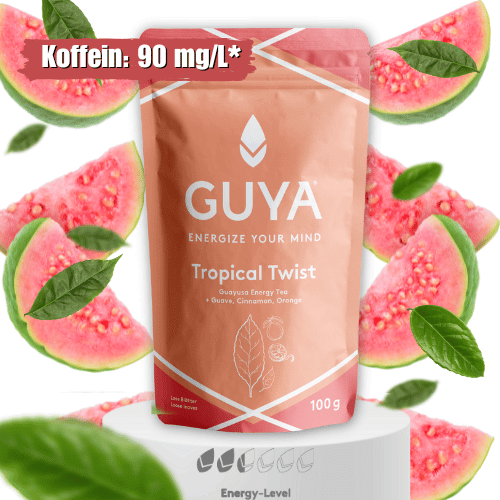
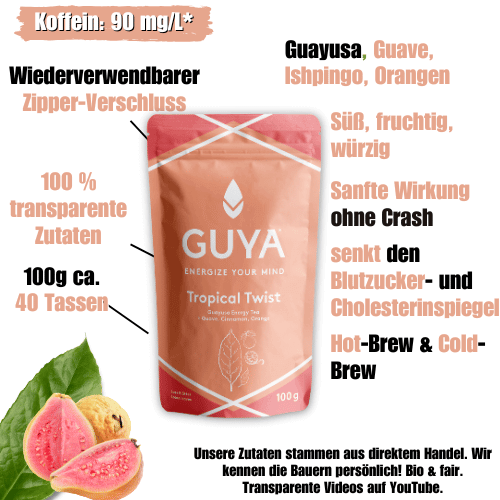
This tea is sweet and tart and refreshing , with a tropical flavor that draws on the fruit's vitamins . An example of a ready-made blend is our Tropical Twist , which combines guava with cinnamon leaves, oranges , and guayusa .
4. Recipe ideas: Enjoy guava tea creatively
Guava tea, made from the leaves of the guava tree, is versatile and can be creatively combined. Here are three recipes that will make your tea a healthy treat.
1. Guava and cinnamon tea for digestion: Combine 1 teaspoon of guava leaves with ishpingo cinnamon in 400 ml of water. Steep for 10 minutes, then sweeten with honey. Cinnamon supports digestion and adds a spicy note.
2. Tropical Guava Iced Tea: Brew 2 teaspoons of guava leaves and 1 teaspoon of dried guava fruit in 500 ml of water. Let cool for 10 minutes, then serve with ice cubes and a splash of orange juice. Refreshing and packed with vitamin C.
3. Guava-Hibiscus Tea for the Immune System: Mix 1 teaspoon of guava leaves with 1 teaspoon of hibiscus in 400 ml of water. Steep for 8 minutes. Hibiscus enhances the antioxidant effect , perfect for fighting colds.
5. Frequently asked questions about guava leaf tea
Do you have questions about guava leaf tea ? Here we answer the most common ones – scientifically sound and practical.
❓ What does guava leaf tea taste like?
It tastes mild and slightly bitter , with an earthy note, similar to herbal tea . With fruit, it becomes sweet and sour . More in the main article under point 2 .
❓ What are the effects of guava leaf tea ?
It lowers blood sugar , supports digestion , and strengthens the immune system with antioxidants . You can find detailed information in section 2, "Effects of Guava Leaf Tea ."
❓ How do I prepare guava leaf tea ?
Pour 1–2 teaspoons of guava leaves into 400 ml of boiling water, let it steep for 5–10 minutes, and sweeten to taste. Detailed information can be found in section 3.1, Basic Recipe .
❓ Can I drink guava tea cold?
Yes, it's refreshing as iced tea ! Brew it hot, let it cool, and serve with ice cubes. Learn more in section 4, Recipe Ideas, in the article.
❓ Where can I buy guava leaves ?
They're hard to find. Our Tropical Twist contains guava fruit, which also offers amazing health benefits. Check out our main article, The Guava Guide .
6. Conclusion: Your healthy guava tea
Summary: Guava leaf tea is easy to prepare, healthy and versatile – perfect for blood sugar , digestion and the immune system .
Guava tea brings the power of the tropics to your cup. It's not only a delight, but also a healthy companion : It lowers blood sugar , supports digestion , and strengthens your immune system .
With our recipes you can enjoy it pure or creatively – whether hot or cold, with cinnamon or hibiscus .
Read more about the effects of guava in the main article or delve deeper into the topic of diabetes in the article Guava against Diabetes .