

DAOs: companies of the future? Potential for customers & businesses

Introduction
DAOs (decentralised autonomous organisations) attract millions of people around the world and let them take part in decisions that would normally be made by only a handful of people.
This article looks at what a DAO is and why it can be a new, value-creating vehicle for companies and customers alike, particularly in relation to transparency, ethics, profit-sharing and much more.
Contents
- What is a DAO? Definition
- History: the first DAO
- Challenges for companies and customers in the current system
- What potential do DAOs offer companies and customers?
- Conclusion: can a company achieve more when structured as a DAO?
1. What is a DAO? Definition
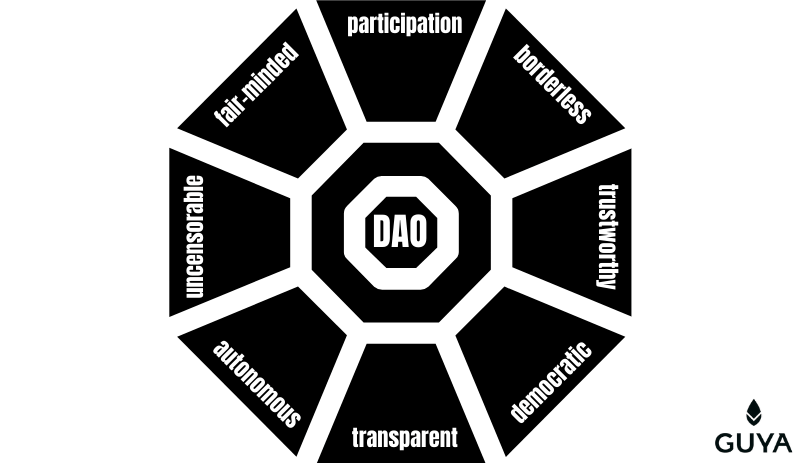
“A DAO (decentralised autonomous organisation) is a group of like-minded individuals coming together in a hierarchy-free community to achieve more together and make decisions transparently with the support of blockchain technology. ”
These decisions can focus on a wide range of areas. Examples include:
- Finance
- Charity
- The common good
- Politics
- Business
DAOs rely on transparent blockchain technology to eliminate completely the risk of fraud by intermediaries such as institutions or individuals. With the help of smart contracts, rules are set in advance and embedded as code in the blockchain (for example, Bitcoin and Ethereum). These rules can be changed only after a vote and approval by DAO members.
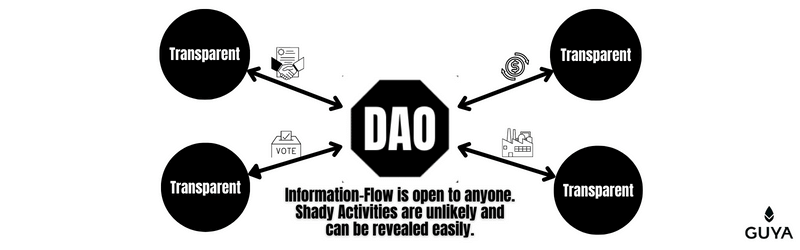
This puts an end to financial-market fraud, abuse of power in politics and opaque companies. Everyone can trace every decision, transaction and the origin of all raw materials a company uses to make a product, at any time and indefinitely.
2. History: the first DAO
Earlier parallels to today's DAOs include brotherhoods and “fraternity societies”: groups formed by many people to pursue shared goals. The first fraternity was founded in 1776 and was called Phi Beta Kappa.
2.1. The first DAO
The first DAO in the modern sense was created in Germany in 2016 by programmer Christoph Jentzsch and was called “The DAO”. Its aim was to manage community funds for both non-profit and for-profit projects. The DAO was one of the largest and most promising crowdfunding projects in history.
Programmers often say, “Code is law.” Just days after it launched, The DAO fell victim to a hack that exploited a flaw in its code to steal millions in community funds.
Despite this apparent failure, the project went on to inspire many people. The community stuck together and compensated all investors by reverting the code to an earlier state. Ethereum, now the world's second-largest blockchain project, was born.
3. Challenges for companies and customers in the current system
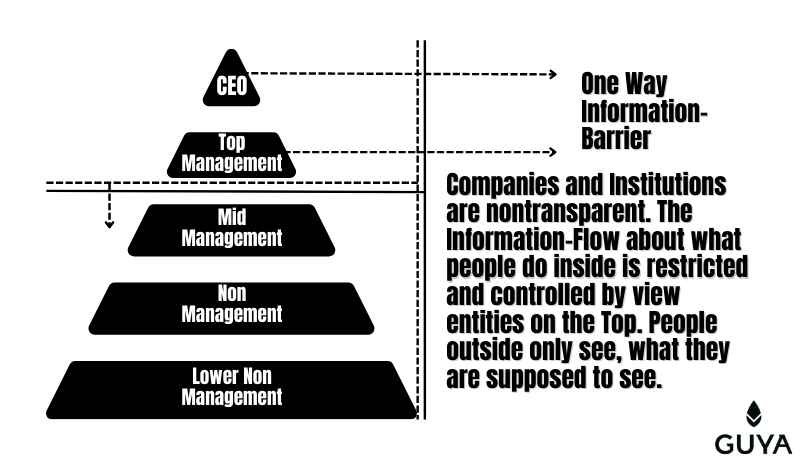
Companies face challenges every day. It is becoming increasingly difficult for new businesses to establish themselves in a world dominated by corporations. Without millions in funding, it has become almost impossible to run marketing campaigns and reach new customers. At the same time, customers lack transparency and a say in decisions.
Corporations, by contrast, grew during a period without regulation or excessive competition. Marketing campaigns that are prohibited today were once allowed. Dubious certification labels and sophisticated campaigns still help corporations evade new rules or use them to their advantage, thanks to the resources at their disposal.
Customers no longer know which companies, seals or institutions they can trust. Attempts to look behind the scenes end in confusion because of a lack of transparency. The desire to help or have a say is frustrated by inaccessible hierarchies.
4. What potential do DAOs offer companies and customers?
But what if a company such as Nestlé, Coca-Cola or VW were not run solely by a CEO and a handful of advisers?
What if these companies were guided by thousands or even millions of people? Scandals such as slave labour at VW and water shortages in Africa caused by Nestlé might never happen. Yet the value of these companies would not be lower, and more people could take part.
Restructuring existing corporations as DAOs is probably close to impossible, but it could open up unexpected opportunities for new and young businesses.
4.1. Fundraising
For small companies, securing funding is difficult in most cases. Banks are unwilling to take risks. Crowdfunding is limited by location and often raises too little, while venture-capital firms are only slightly more willing to take risks than banks.
A DAO, by contrast, allows people from all over the world to invest in a project without geographical limits and, thanks to blockchain technology, have a say in its direction.
In this way, companies can gain capital, customers and supporters.

4.2. Employees
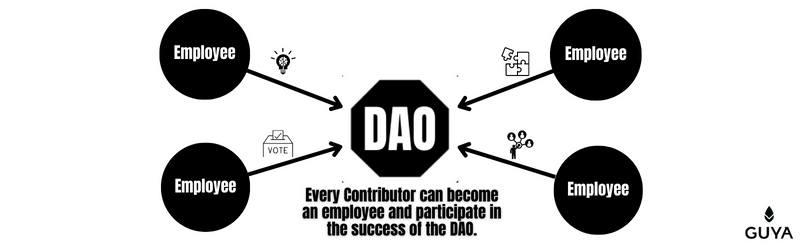
Hiring thousands of employees around the world in a single day is far-fetched even for corporations. For a DAO, however, it is entirely conceivable. Anyone with an internet connection and a phone or laptop can take part in a DAO.
All participants can contribute suggestions for improvements, product ideas, business contacts, knowledge or even simple votes.
The larger a company's DAO community, the greater its potential chance of success.
4.3. Marketing
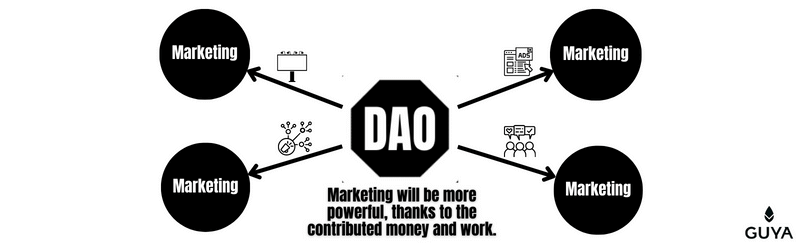
Marketing starts with a community that uses and shares a company's product because it is enthusiastic about it. A community that can help decide on a new product is naturally motivated to buy, use and share it with others.
In addition, the DAO treasury, which receives new funds with each new DAO member, can support marketing campaigns on a corporate scale.
4.4. Transparency and credibility
A DAO could address the lack of transparency in companies and corporations. Decisions about where raw materials come from and how employees and suppliers are treated would be openly visible on the blockchain.
Customers would no longer have to trust dubious and equally opaque certification seals and their promises.
4.5. Customer and user participation
With a right to participate and a company's direction visible to all, seals may become unnecessary or be reshaped entirely.
Communicated values and subsequent actions can be viewed and compared at any time. If a company's stated values no longer match its actions and marketing campaigns, customers who are not part of the DAO can also turn away from it. DAO members can intervene early and help steer the company back on course.
4.6. Exclusive benefits for DAO members
DAO members can be granted exclusive rights.
Blockchain technology makes it possible to identify members through tokens or NFTs and offer them special promotions, discounts, priority purchase rights and much more.
This creates privileges that provide further incentives to participate in the company, use its products and tell friends about its successes.
4.7. Profit allocation
Alongside ethics and self-determination, profit-sharing will be another reason many people choose to participate in a DAO.
A share of the profits generated by the company can be distributed to DAO members. In this way, customers are rewarded for using the products, telling others about them and helping shape new products through voting.
The DAO is entirely free to decide how this profit allocation works.
- Full distribution of profits
- Partial distribution and partial reinvestment
- Distribution to all DAO members or
- distribution only to members who actively take part in votes
- Tiered distributions depending on the level of participation in the DAO
These are just a few examples of how the company's profit treasury, operating on the basis of the DAO, could be divided.

5. Conclusion: can a company achieve more when structured as a DAO?
DAOs are becoming an increasingly popular way to influence world events. Each DAO creates its own small universe of interests which, on closer inspection, can have far-reaching effects. DAOs make collective yet efficient decisions possible. They can make ethical and transparent business practices economically viable, and raise and manage funds through a new form of fundraising before distributing profits to members.
However, because the technology is new, DAOs bring risks such as hacks and challenges such as coordination and execution. Solutions can nevertheless be found for these challenges.
By their fundamental structure, DAOs are open to people around the world. Racism and other forms of discrimination do not exist in a DAO. Anyone who wants to take part and take on more tasks within a DAO can do so by voting and submitting proposals.
The more people take part in DAOs, the more likely they are to succeed. Depending on their focus, small local projects and worldwide initiatives alike can have a huge influence on the direction humanity takes.
DAOs could challenge centralised corporations that have grown for decades without regulation, and help set a direction for institutions such as governments. And all this can happen quickly through the network effect.