

Decentralizing companies and giving customers a voice in a DAO

Introduction
Decentralised autonomous organisations, or DAOs, give you as a consumer and customer the opportunity to help shape the direction of companies and the products they create.
Today, consumers can choose from a wide range of products. If you don’t like one, you can use a similar product from another company. But what if products in an entire category don’t meet your needs for various reasons? You have no way to influence what is offered unless you become an entrepreneur yourself and make a substantial investment. Company decentralisation offers an innovative way for you, as a consumer, to have a say.
Contents
- How companies are structured today
-
How a DAO (decentralised autonomous organisation) is structured
- Conclusion: decentralising companies into a DAO
1. How companies are structured today
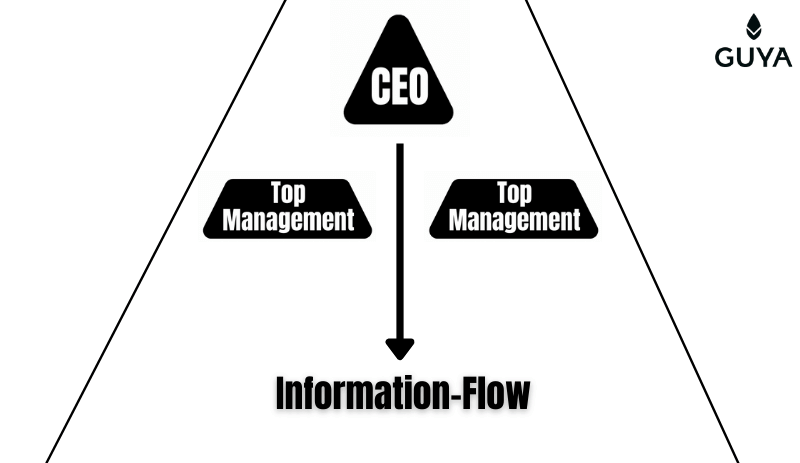
Common company structures today are hierarchical, so a small group of people decides how a business should operate. This is usually the CEO (chief executive), and in larger companies and corporations also a team of advisers and managers.
This kind of company structure can have advantages, such as enabling quick action in an emergency. A CEO or manager does not necessarily have to ask employees for permission before making changes.
However, emergencies like these are rare. More common are long-term decisions that take days, weeks or months to prepare. In large companies, these decisions are made without employees or customers. There are reasons for this: existing company structures face several challenges:
- Few incentives for employees and customers to get involved
- Few incentives for managers and CEOs to allow a vote
- The need for transparency within the company
- The technical means to implement this smoothly
Existing companies are therefore more like one-way streets: ideas, actions and information are generated within the organisation and passed outwards in only one direction.
This is particularly unattractive when it comes to transparency for customers and employees. It also creates a high risk of fraud and unethical behaviour.
2. How a DAO (decentralised autonomous organisation) is structured
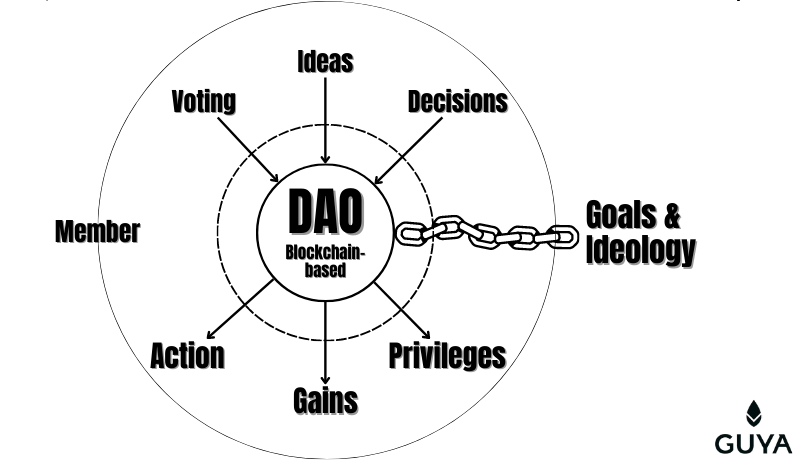
A decentralised autonomous organisation, or DAO, is more like a roundabout where people can view, participate in and make decisions about what happens within the company from many different directions. A DAO’s decentralised structure and nature therefore offer many advantages over a conventional company structure.
2.1. Advantages of a decentralised company structure
Because a decentralised company structure is transparent, employees, customers and even independent outsiders such as research institutes can see what is happening. This is particularly important when it comes to:
- The origin of resources
- The production of goods
- Environmental protection
- The treatment of suppliers (fair trade)
- Respect for human rights
- The management of funds
2.2. How a DAO works
Decentralisation is becoming increasingly important in the financial sector, and is likely to play a role in politics and business in the future too.
The reason is that a decentralised structure puts power in the hands of many rather than a few. Our steadily growing society is built on a centuries-old system which, as it continues to grow, may lead to collapse or even greater centralisation.
A DAO offers a way out of this opaque centralisation by removing the need for central authorities to authenticate participants.
This is done through blockchain technology. At its most basic, a blockchain is a digital sequence of information that, once the DAO’s members have voted, can no longer be changed. This rules out manipulation.
2.3. Having a say in a DAO
In practice, setting up a DAO is similar to founding a company. One or more people create a kind of charter that sets out its goals and how they are to be achieved.
Other people who identify with the goals and principles of the DAO can then join. Joining is similar to taking a stake in a public company: you buy a ticket (called an NFT or token). Because DAOs are straightforward to join, people anywhere in the world can do so, regardless of where they live, as long as they have a mobile phone or computer with an internet connection.
Once they have bought a ticket, members can identify themselves within the DAO and take part. They can put forward ideas, vote and influence decisions. They can even carry out work as employees.
Depending on how active they are in the DAO, members may receive additional benefits, such as product discounts, participation in promotions, first refusal on new products and even profit distributions.
A DAO’s decentralised structure can therefore enable millions of people to share in a company’s success. Customers are no longer necessarily just consumers: they can become active participants with influence, rewarded for their loyalty and any contribution they make.
2.4. Decentralising existing companies
In theory, existing companies—even global corporations—can also be converted into DAOs. In practice, however, this is more likely to happen with small and medium-sized businesses and start-ups. Find out how DAOs could change the world’s biggest corporations in our article “Can DAOs change the world’s biggest corporations?”
3. Conclusion: decentralising companies into a DAO
Decentralised company structures could provide a basis for the businesses and customers of the future. DAOs make it possible to build communities whose members share common goals. Thanks to the network effect, new decentralised businesses have an advantage over existing companies, which have to spend a great deal on marketing, market research and employees.
To learn more about the advantages, we recommend our article “DAOs: the companies of the future? Potential for customers and businesses”.
At the same time, the transparency of events within a DAO, which can be checked at any time, helps restore trust in companies.
A DAO’s greatest strength is also its greatest challenge. Without an active community, a DAO cannot succeed.