

Can DAOs transform today’s corporate giants?

Introduction
Corporations and companies are black boxes. Information is heavily filtered before it reaches the outside world, making it easy to communicate values that are generally popular while acting in a completely different way. A DAO can address this lack of transparency and one-way flow of information.
At the same time, DAOs give you, as a customer, the chance to stop taking things on trust and check at any time whether a company whose products you use is actually telling the truth.
Contents
- Problems with today's companies and corporations
- How DAOs can solve problems for companies and customers
- Conclusion: mega-corporations as DAOs
1. Problems with today's companies and corporations
Today's companies and corporations are shaped by hierarchical pyramid structures, in which one or a few people at the top make the decisions.
Employees and outsiders have no say in decisions and cannot see which decisions are made, or on what terms. This creates enormous opacity that decision-makers such as CEOs and managers can easily exploit.
This abuse of a lack of transparency can take many forms:
- Embezzlement
- Unethical business practices
- through child or slave labour
- through damage to the planet
- through exploitation of vulnerable people
- Planned obsolescence
- Racism
This can happen only because of the lack of transparency and resulting lack of oversight. Transparency and oversight should not be imposed through regulation, however, but enabled by mechanisms within companies themselves that neither restrict their activities nor create extra costs.
2. How DAOs can solve problems for companies and customers
The prospect of higher costs, extra work and reduced competitiveness usually deters companies and corporations from acting transparently and ethically.
Money would have to be invested in these areas, leaving less for other areas such as marketing. To succeed in the market, companies therefore need to reduce costs in every area that does not directly increase sales.
DAOs address the extra costs of transparency and oversight, while also making cost-effective, efficient marketing possible through community-building.
If you want to understand exactly what a DAO is and how it works, read our article “DAOs: companies of the future? Potential for customers and businesses”.
2.1. Transparency and trust in a DAO
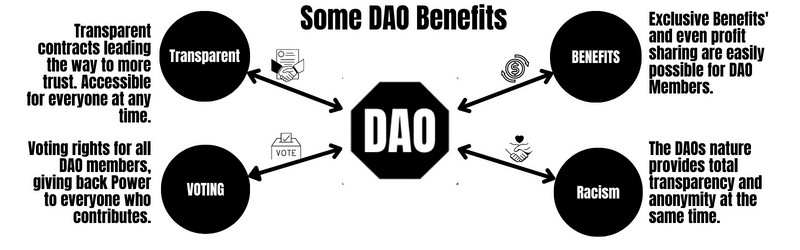
A DAO, or decentralised autonomous organisation, uses blockchain technology to offer a fully transparent, cost-effective and efficient way to build trust among customers and everyone outside an organisation or company.
It does this by continually publishing ideas, decisions and actions intended to shape the company's future.
By nature, these publications can be accessed by anyone in the world, free of charge, at any time and indefinitely. It is therefore easy to identify discrepancies between a company's stated goals and values and what it actually does.
If a DAO or company aims to create a fairly traded and organically grown product, a DAO would define precise conditions in advance:
- What does “fairly traded” mean?
- What does “organically grown” mean?
All subsequent company activity is documented too. DAO members could intervene if the company acted against the rules defined for the product.
This could prevent the problems mentioned above, such as embezzlement, unethical business practices, planned obsolescence and racism.
2.2. Having a say in the DAO
A DAO is built on its members. A single CEO or small group of managers can no longer decide alone which direction the company takes.
A DAO is therefore free of hierarchy, but not of structure. Experts within the DAO or employees hired by it put forward and carry out ideas, improvements and actions. Expert groups can form, but they cannot make final decisions: those require a vote by all DAO members.
This creates a direct, unrestricted democracy.
2.3. Exclusive benefits and profit-sharing for DAO members
DAO members hold a tamper-proof ticket, also called an NFT or token. The company can use this ticket to offer all DAO members exclusive discounts, priority purchase rights and even a share of profits.
This is similar to owning shares, but is much more efficient, simpler and easier to implement across borders.
2.4. Racism
A DAO can provide complete anonymity for its members while ensuring absolute transparency about decisions. A member's background or place of origin no longer matters.
Anyone with an internet connection and a phone or computer can become a member. There are therefore no advantages or disadvantages based on a member's background. What matters is the qualities each member can contribute to make the DAO more likely to succeed.
3. Conclusion: mega-corporations as DAOs!
Restructuring corporations such as Nestlé and VW as DAOs after the fact seems rather utopian. DAOs could, however, give small and new companies a way to challenge dominant corporations and revolutionise the way business is done today.
DAOs make it possible to recruit highly qualified people worldwide, build a community of fans at the same time, and operate cost-effectively, transparently and ethically.
For most people, however, DAOs are still unfamiliar. Pioneers are needed to found DAOs, join them and send a signal in a new direction.