

Cacao ceremony: recipe, ingredients, effects and where to buy cacao
Introduction
In this article, we’d like to give you an insight into the world of cacao. You’ll learn about cacao’s historical significance, ceremonies, effects and ingredients, and discover a cacao tea recipe to try for yourself.
Contents
- What is a cacao ceremony?
- Which cacao is suitable for a ceremony?
- Key effects of cacao in a ceremony
- Cacao ceremony recipe
- Buy ceremonial cacao
- Conclusion
1. What is a cacao ceremony?
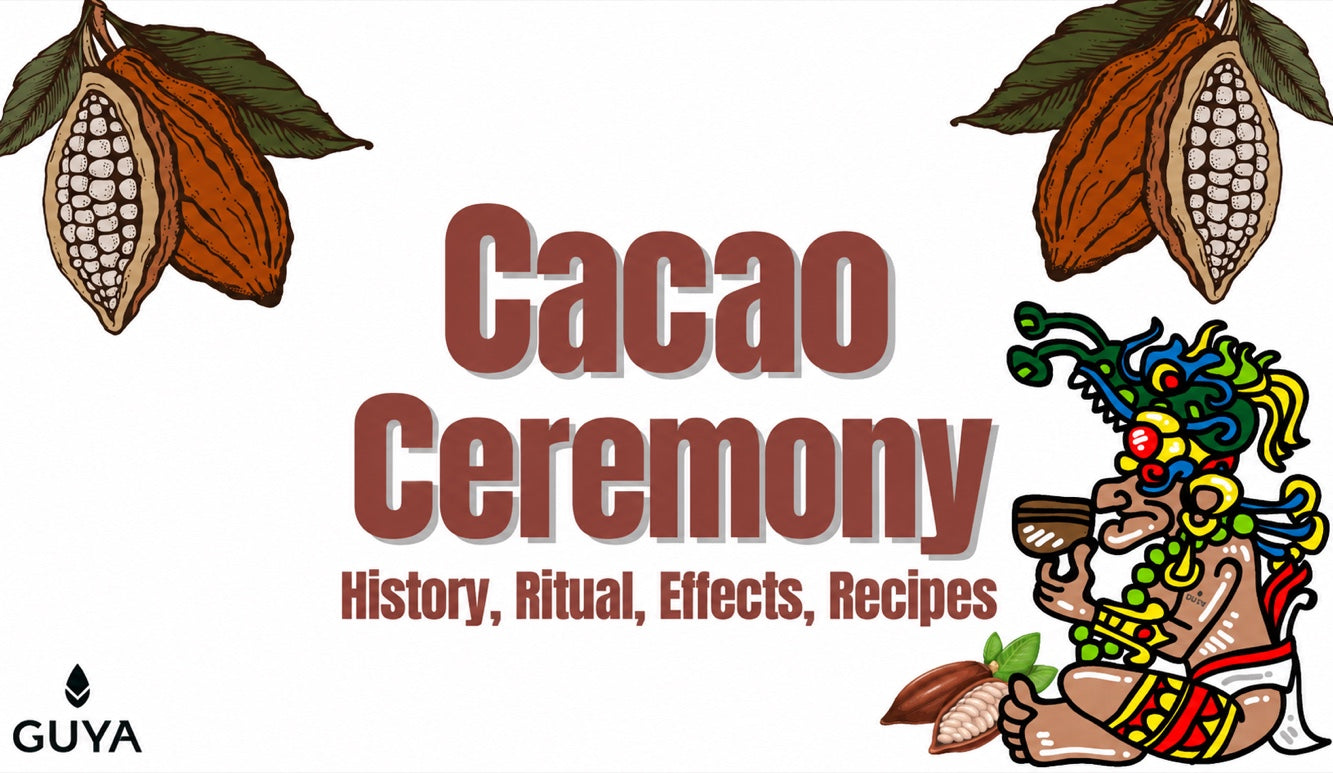
The cacao ceremony originated in South America in the time of the Inca and Maya. Cacao was called the ‘fruit of the gods’—Theobroma Cacao. The ritual is therefore associated with the goddess Cacao, guardian of sacred wisdom and strength.
The aim of the ritual is to restore balance between nature and people. The ritual can release inner blocks, encourage creativity and create harmony.
However, it’s important not to enter the ceremony with these exact expectations, but with an intention. Don’t fix your thoughts on a particular goal, such as releasing a block; instead, stay open to whatever comes up for you during the cacao ceremony.
1.1 What happens at a cacao ceremony?
Cacao ceremonies usually involve dancing, singing, meditation, a sound experience or a combination of these. At group events, sharing and conversation are often a central part, too.
In the past, ceremony leaders, known as shamans, would prepare for the ritual by fasting for several days. Participants are also strongly advised to have their last meal around 4 hours beforehand and to drink enough water afterwards.
The way the plant is presented is decided before the ceremony begins. Before attending a cacao ceremony, you can contact the leader and ask a few questions to make sure the format and intention are right for you.
- Which country does the cacao we’ll be using come from?
- What is the ceremony’s intention, and what activities can I expect?
- How many people will be taking part?
There are generally no fixed rules for this ritual. It can be held outdoors or indoors. The focus is on inner wellbeing.
Rituals are always connected with a particular intention. You should clarify your own intentions or reasons beforehand and, as mentioned above, ask the leader about theirs in advance. These questions may help:
- Would you like to face a feeling or issue that you’ve been suppressing for a long time?
- Would you like clarity about a particular situation or area of your life?
- Would you simply like to share in the joy and openness of the group?
1.2 Benefits of a cacao ceremony
A cacao ceremony may help you gain inner clarity about your own intentions and heal past wounds through inner work. Being physically away from your everyday life, along with the exceptionally energised ceremonial space, creates an environment where you can step out of your daily mindset and gain new perspectives.
Depending on whether you take part in an individual or group ceremony, you may also form an intense human connection with the other participants. Sharing cacao during the ceremony brings everyone onto a similar energy level, creating a deeper and more mindful connection with one another and with yourself.
Participants report a positive group atmosphere, greater enjoyment of life, increased empathy and a warm, open heart. In this way, even a ceremony with strangers can become an opportunity to share and learn: through another participant’s shared experiences, you may learn something about yourself and your place in life.
A cacao ceremony is a spiritual experience for your body, mind and spirit. And while all of this may sound like hocus-pocus, it isn’t so different from meeting up with friends and having a few glasses of wine or beer: the same energy is there, even if it feels different!
1.3 Is a cacao ceremony right for me?
Every cacao ceremony and every teacher is different. It’s a good idea to find out more about the format, the teacher and their intention beforehand. This will give you an idea of how the ritual will unfold and whether it aligns with your own intentions. You’ll also find out whether it is more externally or internally focused. You can use the questions in section 1.1.
If a group ceremony doesn’t feel right to you, there are also 1:1 cacao rituals, which can be shaped just as freely and may range from meditation and a walk in the woods to ecstatic dancing.
If you’re looking to work through past trauma or do particularly deep inner work, a 1:1 cacao ceremony may be more suitable, as you’ll receive intensive support from the teacher. A regular group ceremony, by contrast, is more focused on collective energy and bringing like-minded people together.
2. Which cacao is suitable for a ceremony?
Your options include cacao mass, nibs or powder
2.1 Cacao mass
There’s no limit to the options here either. Raw cacao mass, for example, still contains the cocoa butter, which gives it a pleasant, creamy consistency.
2.2 Nibs
With nibs, grinding them and turning them into a mass can be laborious. The process can also produce very different flavours, as it is difficult to achieve a consistent texture by hand. On the other hand, the extensive preparation becomes a ritual in its own right.
2.3 Powder
Alongside cacao mass, cacao powder is also excellent for preparation, as long as you use a powder that hasn’t been heavily defatted. Apart from the oil, the cacao ingredients are the same. We recommend the cacao from Goodmood.
3. Key effects of cacao for a ceremony
Cacao can be enjoyed outside a ceremony, too. It contains many important compounds and has an impressive effect on the human body. Below, we describe the effects of individual active compounds. If you’re particularly interested in health aspects and histamine, we recommend our article ‘Is cacao healthy? Ingredients, effects, histamine & preparation’.
3.1 Cacao ingredients and active compounds
Who would have thought that cacao is considered a superfruit?
Cacao beans contain a wide range of valuable ingredients, including fats, vitamins, minerals, polyphenols and methylxanthines such as theobromine and caffeine. The number of antioxidant polyphenols is why the cacao bean is considered beneficial to health and may also have disease-preventing uses.
3.1 Theobromine
As the name suggests, theobromine is a key ingredient of Theobroma Cacao (the cacao bean). The active compound theobromine is also found in the Guayusa plant and in tea leaves.
What makes it special is its anti-inflammatory and stimulating effect on the circulatory, respiratory and digestive systems. You’ll definitely feel these effects of cacao during the ceremony.
3.2 Theophylline
Unlike theobromine, theophylline is present in cacao only in small amounts. Find out more about theophylline and its effects in the linked article. In general, theophylline has a performance-enhancing effect on our bodies.
3.3 Antioxidants
Our bodies need antioxidants to protect against oxidative stress caused by so-called free radicals. The ORAC value is used to determine the values of various foods. ORAC stands for ‘Oxygen Radical Absorbance Capacity’, meaning ‘the ability to absorb oxygen radicals’. The ORAC value is generally expressed in Trolox per 100 g (as a unit). It indicates how many antioxidants are present in a fruit, vegetable, tea leaf or cacao bean. Find out more about the role of antioxidants in our dedicated article.
Cacao beans contain more antioxidants than many other foods. Below you’ll find the antioxidant content per 100 g in cacao products:
- Cacao powder 803.7 μmol
- Baking chocolate 456.8 μmol
- Dark chocolate 198.0 μmol
- Milk chocolate 62.0 μmol
- Chocolate syrup 63.4 μmol
The more heavily processed the cacao bean is, the fewer antioxidants it contains. For a cacao ceremony, you should therefore always use ceremonial-grade raw cacao, which in turn enhances its effects.
3.4 Caffeine
Caffeine in cacao is responsible for a slight increase in cognitive abilities such as attention and focus. However, cacao beans contain only a very small amount of caffeine—around 0.2%, to be precise. If you still have questions about caffeine, the linked article may help.
4. Cacao ceremony recipe
We’ve put together the following recipe to help you prepare for your next cacao ceremony:
First, choose your favourite mug or bowl.
Here are some suggested ratios for milk or water and cacao mass or powder:
- 200 ml: 30 g
- 250 ml: 37.5 g
- 400 ml: 60 g
- 500 ml: 75 g
Instead of cow’s milk, we recommend oat milk; it adds a hint of sweetness. You can also use water, in which case you’ll be making cacao tea. More on that in the next section.
Next, heat your plant milk or water slowly. Make sure the milk doesn’t start to boil; it should only be warmed. Once it is hot, gradually add the raw cacao and stir until it has completely dissolved.
4.1 Adding flavour to cacao
You can now flavour your cacao with ingredients such as coconut blossom sugar, cinnamon, vanilla, honey, cardamom or liquorice.
Coconut blossom sugar makes your ceremonial cacao less bitter and also helps with absorption. You can also add chilli or Coco Amino seasoning sauce, as it stimulates circulation. It’s best to prepare the cacao on the hob, so you can bring all the ingredients to the boil together.
4.2 Cacao tea
As mentioned earlier, cacao tea is also excellent for a cacao ceremony. It is made by boiling cacao with water. The great thing about cacao tea is that you can choose from several options: if you prefer more caffeine, try cacao tea and Guayusa; for a little less of a kick, try cacao tea with chai.
Find out more about the effects of each option and cacao recipes for your own ceremony here: Cacao recipe – how to make cacao tea with caffeine. Enjoy preparing it and savouring it afterwards!
Feel free to message us on Instagram and let us know how you liked the recipe.
5. Buy ceremonial cacao
Do also take a look at our partner Goodmoodfood. Goodmoodfood offers fair and sustainable natural products, just like we do, including organic cacao beans. We, meanwhile, specialise in the world’s most caffeinated leaf, ‘GuaYuSa’; find out more about its unique effects on our blog. We know the owners of Goodmoodfood personally and have already run several promotions together.
6. Conclusion
Cacao has a long history, and cacao ceremonies—which are now becoming more common here too—are an important part of it. Cacao beans contain many important ingredients, which is why they are also considered a superfood.
This kind of ritual usually takes place in a group, but it can also be done 1:1 with a teacher or on your own. You’ll find suitable recipes here for your own cacao ceremony at home.
A cacao ceremony has no fixed rules; it is as individual as the teacher, cacao and participants. Whether it involves dancing, meditation, singing or a combination of everything, the ritual follows a theme and has an intention, but no fixed goal—the outcome remains open. So rather than entering the ceremony with a fixed expectation, you should bring only an intention and let it guide you.
We hope this post has taught you something new and sparked your interest in cacao and Guayusa. Both plants come from South America and go well together. Give them a try—we’d love to hear what you think.