

How bad is tap water for your health?

Introduction
How much do you really know about your tap water? Is tap water healthy, or should you only drink filtered water? How does tea affect your water – or water your tea? There are also plenty of rumours about heavy metals, fluoride, chemicals and hormones in tap water that supposedly make it dangerous.
This detailed blog post explores what the evidence shows and which studies support it.
Contents
- Video: how bad is tap water for your health?
- Is tap water healthy?
- Is hard or soft water better?
- Chemicals and hormones in drinking water – a study on reproduction
- Dangerous chemicals and hormones in tap water
- How dangerous is tap water?
- Tap water filtration systems – water at home
- Which water is best for tea?
1. Video: how bad is tap water for your health?
2. Is tap water healthy?
Whether we need water for tea, coffee or cooking, we generally use tap water.
But is this water really harmless and healthy, as we are led to believe, or could it be dangerous? We use several litres every day, and water is essential to life, so it is extremely important that this everyday resource is of the highest quality.
Before we get into the details and look at whether tap water is good or bad for our health, I can say from the outset: the research does not inspire confidence. Healthy water should be free from hormones, chemicals and heavy metals, but unfortunately our tap water contains them in abundance.
That does not mean tap water is always dangerous. We’ll look shortly at what matters, what you should bear in mind, and how you can make poor-quality water drinkable again.
3. Is hard or soft water better?
A question that is debated far too often concerns hard and soft water. Companies are quick to jump on the bandwagon with plenty of advertising, suggesting that soft water is healthier.
Soft water may taste better, but it is neither healthier nor less healthy. In fact, hard water is a great source of magnesium and calcium and stabilises pH in the alkaline range.
The only drawbacks are to the kettle and the taste: both suffer.
In general, however, you do not need to worry about the effect of hard water on your health.
4. Chemicals and hormones in drinking water – a study on reproduction
In many countries, chemicals are used to make water drinkable in the first place. This is less common in Germany, Austria and Switzerland.
Even so, a great many chemicals find their way into our drinking water. Think of your washing machine, the many industrial facilities and the roads used by cars: they are all connected to the wastewater system.
After treatment, our wastewater flows into rivers, from which we then draw drinking water again.
In large cities, treatment plants often create a cycle between water use and treatment, meaning that you may drink what went down the toilet the previous evening.
The treatment plants are clearly very effective, but they cannot filter every single chemical out of the water. This does not make your tap water immediately dangerous or poisonous, but it could have long-term effects on your health.
These chemicals affect our hormones and can damage our entire reproductive system.
According to studies, it is clear that these chemicals cause dysfunction in female egg production and male sperm production, and therefore affect fertility in general.
The study also says that the likelihood of an adverse pregnancy outcome increases. Sperm lifespan is reduced too.
5. Dangerous chemicals and hormones in tap water
Chemicals classified as dangerous in our tap water include, for example:
- Disinfection by-products
- Fluoride
- BPA
- Pesticides
- Oestrogens
According to the German Federation for the Environment and Nature Conservation, these chemicals and hormones are present in our drinking water in excessive amounts.
According to this analysis, during low-water periods German rivers and streams, including those in southern Hesse, can contain up to 100% wastewater. The figures elsewhere are not much better, at 25% to 60%.
The study says that municipal water-treatment plants cannot filter out 100% – or even 99% – of the chemicals and hormones in our wastewater, so these substances return to our drinking water.
6. How dangerous is tap water?
According to the German Federation for the Environment and Nature Conservation, the study on the reproductive system and a study of fluoride in drinking water, the hormones and chemicals mentioned above can cause the following serious illnesses.
- Thyroid damage, leading to:
- Metabolic disorders
- Drowsiness
- Lack of energy
- Depression
- Cancers, such as:
- Breast cancer with a latency period of up to 20 years
- Abnormal changes to the reproductive organs
- Epididymal cysts, undersized testicles, undescended testicles, an undersized penis
- Low sperm count
- Reduced semen volume
- Impaired brain development in children
- Weakened immune system
7. Tap water filtration systems – water at home
So, naturally, the question is whether you should filter your water.
That depends very much on you and the region where you live.
If you have no problems with your metabolism, mood or sleep, filtering your water may not be necessary at the moment.
However, some illnesses, such as cancer, may not appear until decades later, so taking preventive measures can make sense.
I’d therefore like to show you two possible types of water filter for home use, how they work and how effective they are.
7.1. Gravity water filters

You can think of these handy filters as water jugs. They can be suitable for a single-person household and for preparing water for tea.
However, be careful. Not every retailer offers filters of sufficient quality. Gravity water filters often remove only limescale, simply making the water softer.
When buying one, make sure that the filter removes fluoride, chemicals and hormones. You could, for example, look at the ‘Invigorated Water’ brand.
7.2. Reverse osmosis water filters
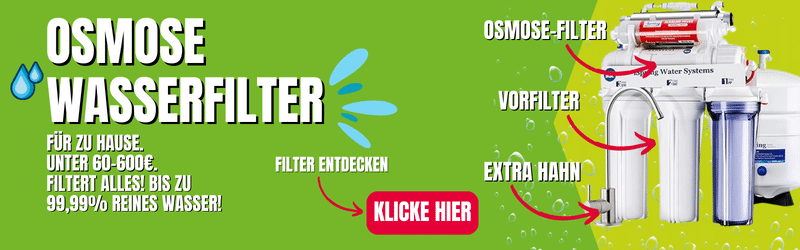
A reverse osmosis system is the most powerful form of water filtration. It uses pressure from the water supply to push water through several filters, which gradually remove individual components.
Water filtered by reverse osmosis is therefore the purest water you can get. Even hormones are removed.
One drawback of this filtration method is that it also removes beneficial components such as magnesium and calcium.
However, if you mainly use the water for tea or cooking, reverse osmosis is the best way to purify it.
Reverse-osmosis water is also suitable for drinking. However, it is generally recommended that minerals be added back to the water. This happens automatically when tea is prepared.
For example, guayusa leaves contain sodium, potassium, zinc, phosphorus and magnesium.
You can find reverse-osmosis systems in various models from these two suppliers: iSpring and OsmoFresh.
8. Which water is best for tea?
Tea drinkers will always tell you the same thing: ‘You need soft water to make good tea!’
The reason soft water is better for tea is that tea components – including minerals, flavour compounds and active ingredients such as caffeine – can develop more easily when there are fewer other substances in the water.
Everyone knows the chemistry experiment in which low-salt water and salty water are separated by a membrane. After a while, the salt concentration in both areas equalises, but the exchange gradually slows towards the end.
Tea works in a similar way. The active ingredients in guayusa tea can pass into clean, healthy water more easily than into hard water.
Hard water therefore affects both the taste and the amount of active compounds.