

Black tea caffeine: mg per cup compared

Introduction
This short article looks at how many milligrams of caffeine black tea contains and compares the figures with other caffeinated drinks.
Finally, we’ll look at why black tea has a different effect and sum things up briefly.
Contents
- What is black tea?
- How much caffeine does black tea contain?
- Why does black tea have a different effect?
- Conclusion
1. What is black tea?
Black tea is made from green tea. All teas – whether green, black, white or yellow – come from the tea plant Camellia sinensis.
The difference lies in how the harvested leaves are processed, which produces different flavours and caffeine levels. For green tea, the leaves are treated with hot steam soon after harvesting and then dried with hot air. Find out more in our article Matcha vs green tea.
Black tea, on the other hand, is oxidised for a period after harvesting. This oxidation process turns the leaves black and changes their flavour and the proportions of active compounds they contain. We use a similar process for our DARK Guayusa variety.
As we specialise in Guayusa tea, we don’t stock black tea. However, we can recommend Tezen’s shop, which has a wide selection of teas made from Camellia sinensis.
2. How much caffeine does black tea contain?
The amount of caffeine in a prepared cup of black tea depends on the growing region, sunlight and how the leaves are processed.
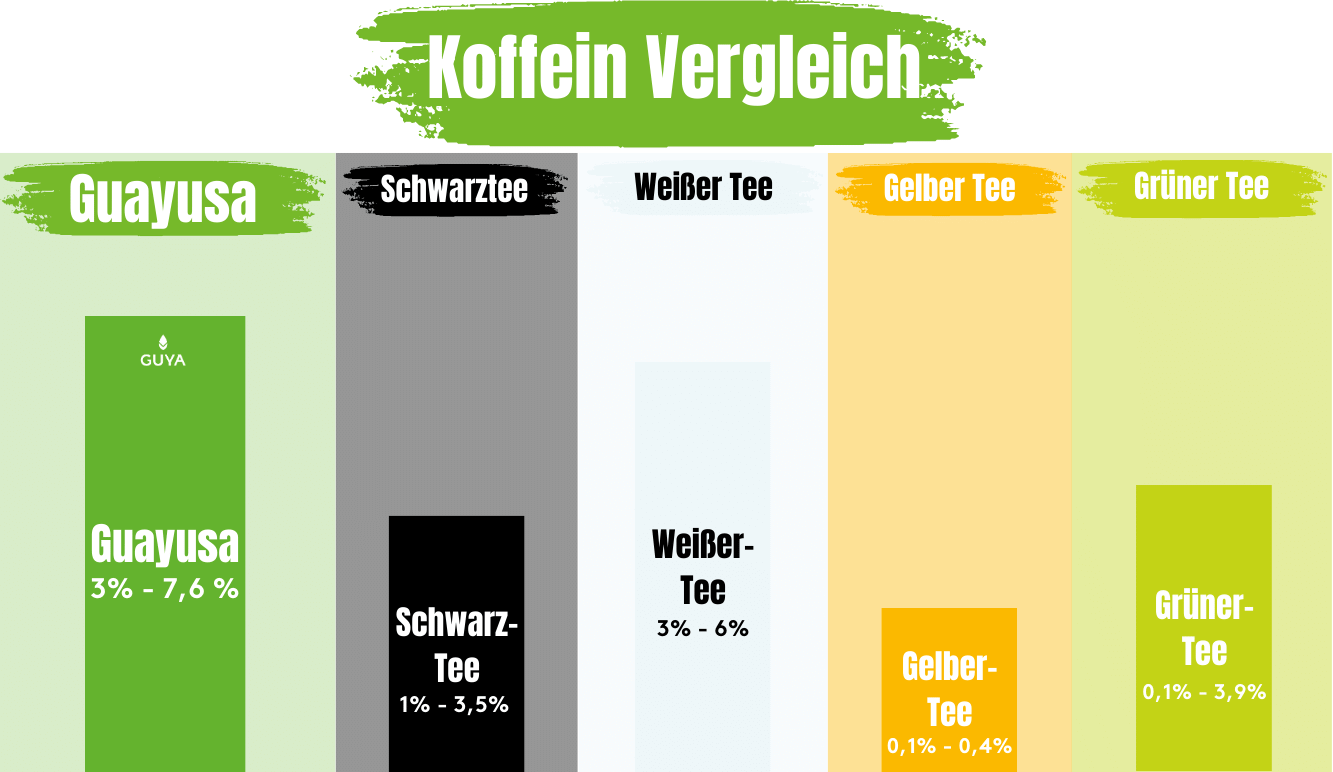
A typical standard black tea contains around 1% to 3.5% caffeine. This percentage is calculated based on the dry weight of the tea leaves.
2.1. How many mg of caffeine does black tea contain?
That works out at 10 mg to 35 mg of caffeine per 1 g of tea. So the caffeine in a cup of black tea also depends on how much tea you use.
For a glass such as our heat-resistant 400 ml borosilicate glass, you would use about 2.5 g of tea. That makes a cup of black tea with around 25 mg to 87.5 mg of caffeine.

2.2. How does black tea compare for caffeine?
A cup of ordinary black tea usually contains more caffeine than regular green tea, but not dramatically more.
Matcha, on the other hand, is also a green tea and contains much more caffeine than black tea, at 44 mg per g.
A 400 ml cup of coffee, by comparison, contains around 90 mg to 120 mg of caffeine, even though coffee itself contains only 1.4% to 3.2% caffeine. That’s because far more grams of coffee are used per cup – 15 g to 20 g is not unusual.
You’ll find a comparison of many caffeinated drinks in our caffeinated drinks comparison.
The graphic below compares the approximate caffeine content of black tea. You’ll see that it doesn’t stand out, and is roughly on a par with green tea.
3. Why does black tea have a different effect?
Many people find black tea more potent than the “weaker” green tea. Since its caffeine content is not much higher, you might think that another active ingredient must explain the difference in effect.
The stronger effect occurs because caffeine can act more quickly. The leaf oxidation process mentioned above destroys antioxidants that were previously present in high amounts in the green leaves.
Caffeinated drinks contain more than just caffeine: they also contain a range of other active compounds, such as theobromine, theophylline and L-theanine. Our article on Guayusa’s ingredients gives an overview of the key compounds.
Some of these other compounds have direct effects, while others act indirectly. Antioxidants, for example, often have effects that are not immediately noticeable, but when they are absent, caffeine acts more quickly. This is why coffee also acts much faster than green tea or Guayusa tea. Coffee has only about 1/7 as many antioxidants as green tea and 1/14 as many as Guayusa tea.
To learn more about possible side effects of black tea, see our article “Side effects of Guayusa, mate, green and black tea”.
Caffeine comparison table
How much caffeine actually ends up in your cup depends on the leaf, the amount and the steeping time. This table shows the usual ranges at a glance:
| Drink | Caffeine in leaf/powder | approx. mg per 200 ml | Effect |
|---|---|---|---|
| Guayusa | 1.9 – 7.6 % (our organic tea approx. 2.5 – 3.2 %) | 30 – 90 mg | awake and calm at the same time (contains L-theanine) |
| Yerba mate | approx. 1.4 % | 25 – 40 mg | caffeine-driven, can be harsh on an empty stomach |
| Matcha / tencha | 0.8 – 3.9 % | 40 – 70 mg | whole leaf, L-theanine, fast onset |
| Green tea | 0.1 – 3.0 % | 20 – 50 mg | gentle, tannins with long steeping |
| Black tea | 0.1 – 3.5 % | 20 – 60 mg | full-bodied, shorter effect |
| Coffee (robusta) | 2.8 – 3.2 % | 80 – 120 mg | fast peak, often a nervous drop |
| Espresso | 1.5 – 3.0 % | 60 – 80 mg | very fast peak, short duration |
The values are typical ranges from literature and our own analyses. They vary with variety, leaf amount, water temperature and steeping time.
Frequently asked questions
How much caffeine does guayusa have?
Guayusa contains between 1.9 % and 7.6 % caffeine depending on variety and leaf. Our organic GUAYUSA averages 2.5 – 3.2 %. With 2 to 3 grams of leaf that is about 30 to 90 mg per cup.
Is guayusa stronger than coffee?
In the leaf, yes: guayusa can contain more caffeine than robusta coffee. In the cup it evens out because tea releases more slowly — and guayusa also provides L-theanine.
Why does guayusa make you less jittery than coffee?
The naturally contained L-theanine and the antioxidants create a more even, longer-lasting effect — without the fast peak and the crash afterwards.
How do you brew guayusa correctly?
With water at 90 – 100 °C and at least 5 minutes of steeping. The leaves can stay in the strainer in the cup until you finish drinking — guayusa does not turn bitter.
Conclusion
The caffeine content of black tea depends on its origin and cultivation, as well as weather conditions.
Compared with green tea, it does not contain substantially more or less caffeine. Its effects differ because of its antioxidant levels: black tea has considerably fewer antioxidants, which allows the caffeine to act more quickly.
This difference in antioxidant levels compared with green tea is due to the different processing: black tea leaves are oxidised.
At around 10 mg to 35 mg of caffeine per 1 g, black tea has a low to moderate caffeine content compared with other caffeinated drinks.