
Matcha vs green tea: which will you choose?
Introduction
As in our comparisons of Matcha vs coffee, Matcha vs mate and Matcha vs Guayusa, here we compare Matcha with green tea. We look at how they differ and whether Matcha or green tea is the better choice.
Contents
1. Matcha vs green tea
If you have read our in-depth article about Matcha tea, you will already know some of the similarities and differences between Matcha and green tea. Here, we take a much closer look at the two drinks.
1.1. Similarities
Strictly speaking, Matcha is the highest-quality green tea in powdered form. Matcha means ‘ground tea’ and is the final processed form of Tencha tea. Tencha, in turn, is Matcha before it is ground.
Matcha and Tencha therefore have identical properties and ingredients, apart from their form.
The biggest similarity between Matcha and ordinary green tea is that they come from the same plant species (Camellia sinensis).
1.2. Differences – Matcha vs green tea
As mentioned, ordinary green tea does share some similarities with Matcha. However, it contains considerably lower amounts of important compounds such as antioxidants, caffeine, L-theanine and amino acids than Matcha.
This is largely true only of Matcha from Japan, however, since any powdered green tea may be called Matcha. As a result, ordinary green teas are also ground and sold as Matcha outside Japan.
When buying Matcha, look for ‘Japan’ as the country of origin and a deep, almost vivid green colour. Find out more in our article about flavour and quality grades.

Growing
For several weeks before harvest, Matcha plants are shaded with black nets. This increases and intensifies the levels of all the compounds: with less sunlight, the leaves produce more chlorophyll, amino acids, antioxidants and caffeine.
Processing
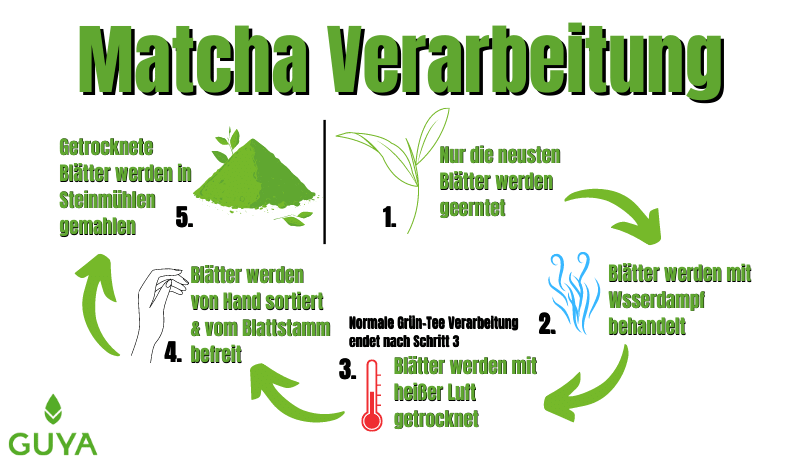
Only the uppermost, freshest and greenest leaves are picked for authentic Japanese Matcha. They are treated with steam and dried immediately with hot air to prevent oxidation. The best leaves are then sorted by hand and stripped of their stems.
The next step is grinding the leaves in a stone mill. With a mechanical mill, the process can take more than an hour to produce 30 g of Matcha.
Origin
The first green tea powder came from China and could therefore be considered the first Matcha. However, what we know today as Matcha tea has little in common with the green tea powder from China.
In Japan, the Matcha-making process was redefined throughout the production chain. So, while the original idea came from China, it is fair to say that today's Matcha comes from Japan.
Green tea can come from many different regions around the world. As with coffee, each region has its own distinctive flavours. Green tea may come from Japan, China, Vietnam, Thailand, Indonesia and India, although tea farms can be found in many other parts of the world too.
Ingredients
In our Matcha vs green tea comparison, Matcha has particularly high levels of active compounds. The difference is especially noticeable in caffeine and antioxidants. Based on its ingredients, Matcha is the choice to consider when asking whether Matcha or green tea is healthier.
Matcha has a similar amount of antioxidants to a patented green tea extract. In terms of these antioxidants, Matcha has about twice as much as ordinary green tea.
A study found that antioxidants—particularly phenols and flavonoids—and the diabetes inhibitor α-glucosidase had better bioavailability in Matcha. The study compared Matcha with Sencha, which is already considered a very high-quality green tea.
Effects
Matcha also comes out clearly ahead in this part of the comparison. Its higher levels of active compounds produce stronger effects, mainly in relation to health. Read more in our blog article about the effects of Matcha.
2. Matcha or green tea?
The comparison suggests that Matcha is the better green tea, but, as the saying goes, it comes at a higher price. 30 g of quality Matcha can easily cost €30 or more. By contrast, 50–100 g of Sencha can cost between €10 and €20.
If you place particular importance on health benefits, choose Matcha when deciding between Matcha and green tea.
3. Conclusion
We often tend to see things in black and white, but the truth usually lies somewhere in the middle. Taking things to extremes often does more harm than good. A bowl of Matcha, a delicious Sencha and a particularly invigorating, healthful Guayusa tea can all sit happily alongside one another.