

L-theanine: effects, concentration, sleep, depression and combinations with caffeine

L-theanine is an amino acid whose effects include reducing stress, improving sleep and supporting concentration. At 100–400 mg a day, often consumed as tea such as Guayusa tea, L-theanine works particularly well with caffeine—and without side effects.
Video summary
Contents
- What is L-theanine?
- Where is L-theanine found?
- Effects of L-theanine
- L-theanine and caffeine—what are their effects?
- L-theanine dosage
- L-theanine side effects
- L-theanine: frequently asked questions
- Conclusion
Introduction
The effects of L-theanine are fascinating in many ways! It has a particularly interesting effect when combined with caffeine. L-theanine may also have a positive effect on sleep and depression.
This article focuses on the effects of L-theanine, so that by the end you’ll understand the potential benefits of this interesting amino acid and how you might use it.
Video on the effects of L-theanine:
1. What is L-theanine?
Summary: L-theanine is a non-proteinogenic amino acid that calms your brain and keeps it focused—without making you sleepy.
What is L-theanine? It is gamma-glutamylethylamide, an amino acid found mainly in Guayusa tea and the tea plant (green tea). Unlike proteinogenic amino acids, it is not incorporated into proteins; instead, it acts directly in the brain by crossing the blood–brain barrier. A study shows that L-theanine influences neurotransmitters such as dopamine, serotonin and GABA, which contributes to its relaxing and concentration-supporting effects.
The effects of L-theanine are often described as a “relaxed yet alert state”—ideal for stressful situations or intensive work. It reduces anxiety, improves cognitive performance and supports sleep, without acting as a sedative.
Especially interesting: L-theanine works synergistically with caffeine. More on that later in the article.
Fun fact: L-theanine was discovered in green tea in 1949. One reason green tea may make you feel more relaxed than stimulated is that it contains more L-theanine and not enough caffeine!
2. Where is L-theanine found?

Summary: L-theanine is rare—it is found mainly in green tea, Guayusa, black tea and one mushroom.
Where is L-theanine found? This amino acid occurs naturally in only a few plants and one mushroom—a real rarity! The main sources are:
- Green tea (Camellia sinensis): Contains about 500 mg of L-theanine per 100 g, depending on the variety (for example, matcha contains more). Several studies confirm that L-theanine in green tea contributes to its calming effect.
- Guayusa: This Amazonian plant provides up to 130 mg per 100 g, with considerably more caffeine than green tea—creating a distinctive sense of focus. Read more in our Guayusa article.
- Black tea: About 5–20 mg per 100 g—less than green tea, but still relevant in heavily fermented tea.
- Bay bolete (Boletus badius): A rare mushroom containing small amounts (about 1–5 mg per 100 g).
Pure L-theanine powder or capsules are extracted, for example, from green tea to allow precise dosing.
How much L-theanine is in green tea? A cup (400 ml) provides about 2 mg, while matcha contains up to 4 mg. For stronger effects, combine tea with supplements or choose Guayusa tea—the special thing about Guayusa is that it also contains more caffeine. The resulting alert, focused feeling is especially pleasant, long-lasting and effective!
3. Effects of L-theanine
Summary: The effects of L-theanine include stress relief, better sleep, improved concentration and more—often without side effects.
L-theanine affects your brain and body in many ways. Here are the main effects, based on studies and practical use:
3.1. General use
Summary: L-theanine is used to reduce stress, improve mental clarity and support sleep quality.
L-theanine is a favourite for people who want to relax without feeling sluggish. It is often taken as tea or a supplement to ease stress, anxiety and mental overload.
The following study shows that L-theanine promotes alpha brain waves, creating a state of relaxed alertness—perfect for work or meditation.
3.2. Concentration and mental performance
Summary: L-theanine improves concentration and cognitive performance—ideal for studying or working.
The effects of L-theanine on concentration have been well studied. It increases dopamine and serotonin, which improves focus and learning ability.
Another study found that just 100 mg of L-theanine increased reaction speed, while errors in tests were reduced. After 12 weeks, attention and memory improved significantly.
Biohackers in particular love it as a nootropic—often combined with caffeine for maximum clarity. Our Limitless Powder, made from Guayusa concentrate, has demonstrated this effect in placebo studies.
3.3. Effects of L-theanine on sleep and recovery
Summary: L-theanine makes sleep deeper and more restful—without sedation.
L-theanine calms the brain without making you sleepy.
A 2011 study also found that 200 mg of L-theanine a day (2 × 100 mg) improved sleep quality in patients with ADHD after six weeks. Further research (MDPI) found that 200–400 mg extends the REM phase and shortens the time it takes to fall asleep. It reduces resting heart rate—ideal for nighttime rumination.
If you have trouble falling asleep and are under a lot of stress, also read our article about GABA—the stress-free molecule.
Or watch our video:
3.4. Managing stress and anxiety with L-theanine
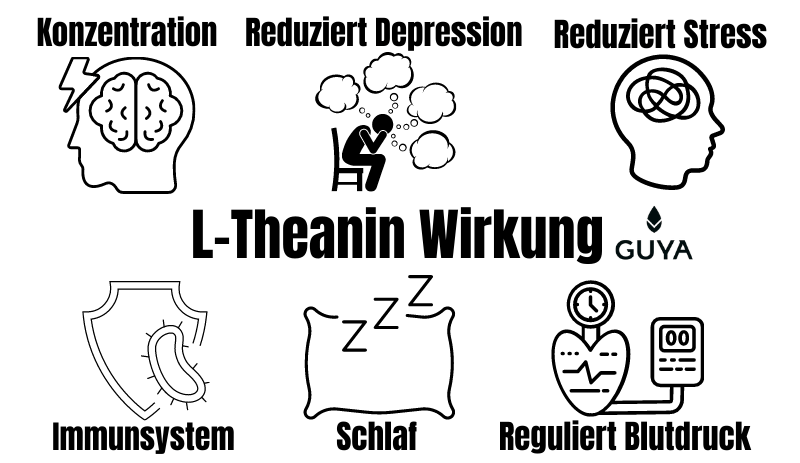
Summary: The effects of L-theanine on stress and anxiety are extremely positive, as these are demonstrably reduced. This leads to a clear head and a relaxed body.
L-theanine has a calming effect without causing drowsiness.
A study reported that 200 mg of L-theanine reduced the stress response in acute situations by moderating cortisol. It promotes alpha waves, which makes L-theanine effective against anxiety.
For anxiety disorders: studies report moderate relief from chronic anxiety, particularly when combined with tea-drinking rituals.
3.5. Effects of L-theanine on depression and mood
Summary: L-theanine reduces depression and lifts your mood.
L-theanine affects serotonin and GABA, which lifts your mood. Studies found that 250 mg of L-theanine a day reduced depressive symptoms in patients with chronic depression. It does not work like antidepressants; instead, it supports balance—a gentle boost on grey days.
3.6. Blood pressure and heart health
Summary: L-theanine regulates blood pressure in stressful situations.
L-theanine helps keep the blood pressure stable.
A study conducted in 2012 found that 200 mg of L-theanine lowered blood pressure in stressed individuals without affecting normal blood pressure.
Japanese research (PubMed) also confirms that L-theanine has a regulating effect by calming the sympathetic nervous system.
3.7. Immune system
Summary: L-theanine strengthens the immune system, for example against infections.
L-theanine supports your immune system by reducing inflammation.
Studies found that regular intake (for example, as Guayusa tea) reduces the risk of respiratory and intestinal infections. It promotes the production of immune cells—a small but welcome boost for everyday life.
4. L-theanine and caffeine—what are their effects?
Summary: L-theanine and caffeine make a powerful duo: they boost focus and energy without jitters.
The combination of L-theanine and caffeine is a well-kept tip for a clear head. Caffeine keeps you alert, while L-theanine dampens the typical jitters.
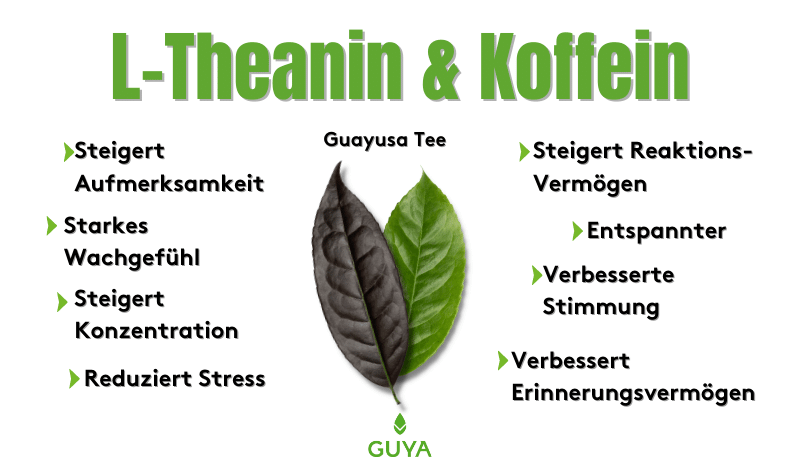
A study on the effects of L-theanine on cognitive performance reports that 100 mg of L-theanine with 50 mg of caffeine improves attention and reaction time, as well as mood—without a crash. Here are the details:
How does L-theanine work with caffeine? L-theanine smooths out caffeine peaks by promoting alpha brain waves and reducing stress hormones such as cortisol. The result: you feel alert, focused and relaxed at the same time.
According to another study, the combination improves cognitive performance more than caffeine alone—ideal for studying, work or sport.
Where can you find the combination? Naturally in Guayusa and green tea, both of which contain L-theanine and caffeine. Guayusa provides up to 130 mg of L-theanine and about 3,000 mg of caffeine per 100 g—a perfect ratio.
To find out how much caffeine is in different energy-boosting products, visit our caffeine calculator.
Who might find it useful? Anyone who wants to avoid coffee jitters!
5. L-theanine dosage
Summary: The right L-theanine dosage is 100–400 mg per day, depending on your goal, such as sleep or focus.
How much L-theanine should you take per day? There is no official recommendation, but studies offer some guidance. A study on improving sleep reports that 100–400 mg of L-theanine can be effective for stress relief, sleep or concentration. Here are the details:
- For sleep: 100–200 mg, 30–60 minutes before bed. A study found that 200 mg improves sleep quality without sedation.
- For stress and anxiety: 50–200 mg, once or twice a day. Research reports that 100 mg reduces acute stress.
- For concentration: 100–200 mg, with caffeine (50–100 mg). A study recommends a 2:1 ratio for focus.
When should you take L-theanine? In the morning for concentration, or in the evening for sleep—preferably on an empty stomach for faster effects.
How much L-theanine should you take for sleep? 100–200 mg is enough; higher doses (up to 400 mg) are considered safe but, according to studies, offer no additional benefit.
L-theanine in the morning or evening? Either works: in the morning with caffeine for clarity, or on its own in the evening to unwind.
Tip: Start with 100 mg and see what works for you. Combine it with Guayusa for a natural synergy.
6. L-theanine side effects
Summary: L-theanine side effects are rare and mild—at normal doses, it is considered safe.
Does L-theanine have side effects? In general, L-theanine is well tolerated because it occurs naturally in teas such as Guayusa, green tea and black tea. Studies report minimal risks at doses of up to 1,200 mg per day. Still, there are a few things to know:
- Drowsiness: High doses (over 400 mg) may cause drowsiness in some people, as a study suggests—this is rare at 100–200 mg.
- Headaches: Is L-theanine dangerous? No, but some users report headaches after taking too much (over 800 mg), according to the results published in 2016 by Jackson Williams on L-theanine as a functional food.
- Interactions: L-theanine may interact with sedatives (such as benzodiazepines) and enhance their effects—use caution with medication. Talk to a doctor if you take antidepressants.
- Stomach discomfort: Very rare, usually with high doses (over 1,000 mg) on an empty stomach.
Is L-theanine dangerous? No. Studies such as this randomised controlled trial, “Effects of L-theanine administration on stress-related symptoms...”, report that up to 1,200 mg per day for eight weeks is safe, with no toxic effects.
L-theanine overdose? Unlikely, but more than 2,000 mg could cause discomfort.
Tip: Stick to 100–400 mg per day, combine it with Guayusa for balance, and read more in our caffeine article or visit our YouTube channel.
7. Frequently asked questions about L-theanine and its effects
Have questions about L-theanine? Here we answer the most common ones—briefly, clearly and with scientific grounding.
From effects to dosage—everything you need to know!
❓ What is L-theanine?
L-theanine is an amino acid in green tea and Guayusa that reduces stress and supports focus. It acts in the brain without causing drowsiness—see section 1.
❓ What does L-theanine do?
Effects of L-theanine: It calms you, supports concentration and improves sleep through dopamine, serotonin and alpha waves. Details in section 3.
❓ Is L-theanine dangerous?
No. L-theanine is considered safe at 100–1,200 mg per day. Rare side effects, such as drowsiness, tend to occur only at high doses—see section 6.
❓ How much L-theanine per day?
L-theanine dosage: 100–400 mg per day—100–200 mg for sleep, 50–200 mg for stress. More in section 5.
❓ When should you take L-theanine?
When should you take L-theanine? In the morning for focus (with caffeine), or in the evening for sleep (100–200 mg). Taking it on an empty stomach may make it work faster—see section 5.
❓ Does L-theanine help with sleep?
Yes. L-theanine for sleep: 100–200 mg before bed helps you fall asleep sooner and supports the REM phase, without sedation. More in section 3.3.
❓ Where is L-theanine found?
L-theanine is found in green tea (500 mg/100 g), Guayusa (130 mg/100 g), black tea and small amounts in bay bolete. See section 2.
❓ How does L-theanine work with caffeine?
L-theanine and caffeine support focus without jitters—100 mg of L-theanine with 50 mg of caffeine is ideal. More in section 4.
❓ Does L-theanine help with anxiety?
Yes. L-theanine for anxiety: 100–200 mg reduces stress and anxiety by moderating cortisol. See section 3.4.
❓ Can L-theanine ease depression?
L-theanine and depression: 250 mg per day may lift mood by increasing serotonin. More in section 3.5.
8. Conclusion
Summary: L-theanine is a natural all-rounder—it reduces stress, supports sleep and improves focus, especially with caffeine.
The effects of L-theanine are impressive: it calms your brain without making you sleepy, improves concentration and may even ease anxiety or low mood.
Studies suggest that 100–400 mg per day—as tea or a supplement—is enough to experience these benefits. The combination of L-theanine and caffeine, as in Guayusa, makes it a favourite among biohackers, students and anyone seeking mental clarity.
Side effects? Few—L-theanine is considered safe up to 1,200 mg per day. Whether you use L-theanine for sleep, stress relief or blood-pressure regulation, it is a natural option without chemicals.
Our tip: Start with 100 mg and combine it with caffeine for a boost. Read more in our articles about caffeine or theophylline.
Your next step? Try L-theanine and find your flow—whether at the office, while studying or in the evening as you unwind!