

Guayusa caffeine content compared with mate, green and black tea
Introduction
In this article, we look at the caffeine content of different teas, including guayusa, green and black tea, and mate. Which tea has the most caffeine, and can tea compete with coffee? Here, we compare the caffeine content of the main drinks. The result may surprise you.
Contents
- How is the caffeine content of mate tea and guayusa measured?
- What are caffeine and theine?
- How much caffeine does guayusa contain
- How much caffeine does coffee contain
- Yerba mate tea caffeine content vs guayusa caffeine content
- How much caffeine is in green and black tea?
- Conclusion – how does guayusa’s caffeine content compare?
1. How is the caffeine content of mate tea and guayusa measured, for example?
Caffeine content is generally measured in mg or as a percentage of dry matter, whether it is mate, guayusa or green tea.
However, online it is not always clear whether the figures refer to the dry matter or to the prepared drink. Since the amount used varies from person to person, all figures in this article refer to dry matter.
2. What are caffeine and theine?
What is the difference between caffeine and theine?
2.1. What is caffeine
Caffeine is an alkaloid found in more than 63 plant species. It has a strongly bitter taste; it also stimulates energy expenditure and boosts your metabolism. For a detailed comparison of the best-known caffeinated drinks, see our free e-book ‘Energy Boosters Compared’.
Caffeine’s effects are focused largely on the central nervous system. At a moderate dose of around 150 mg, caffeine therefore mainly has a positive effect on concentration. It increases memory capacity and recall. Caffeine can also produce mild euphoria, stimulate the mind and help counter drowsiness. Read more about other active compounds in our overview of ingredients and their effects.
2.2. What is theine?
Chemically, theine and caffeine are one and the same substance. In the 19th century, tea’s stimulating effect was attributed to a different substance from caffeine, and this substance was called theine.
We now know that theine is caffeine. However, caffeine in mate tea and guayusa tea can have a different effect from coffee caffeine, because mate and guayusa contain natural polyphenols. If caffeine were extracted from any plant, however, it would always have exactly the same effect.
So it is the combination of all the active compounds that matters!
3. How much caffeine does guayusa contain
Indigenous peoples have used the leaves of the guayusa tree for more than 2,000 years. One reason is its high caffeine content. No other plant has as much caffeine in its leaves as guayusa. Read our detailed article about guayusa tea here.
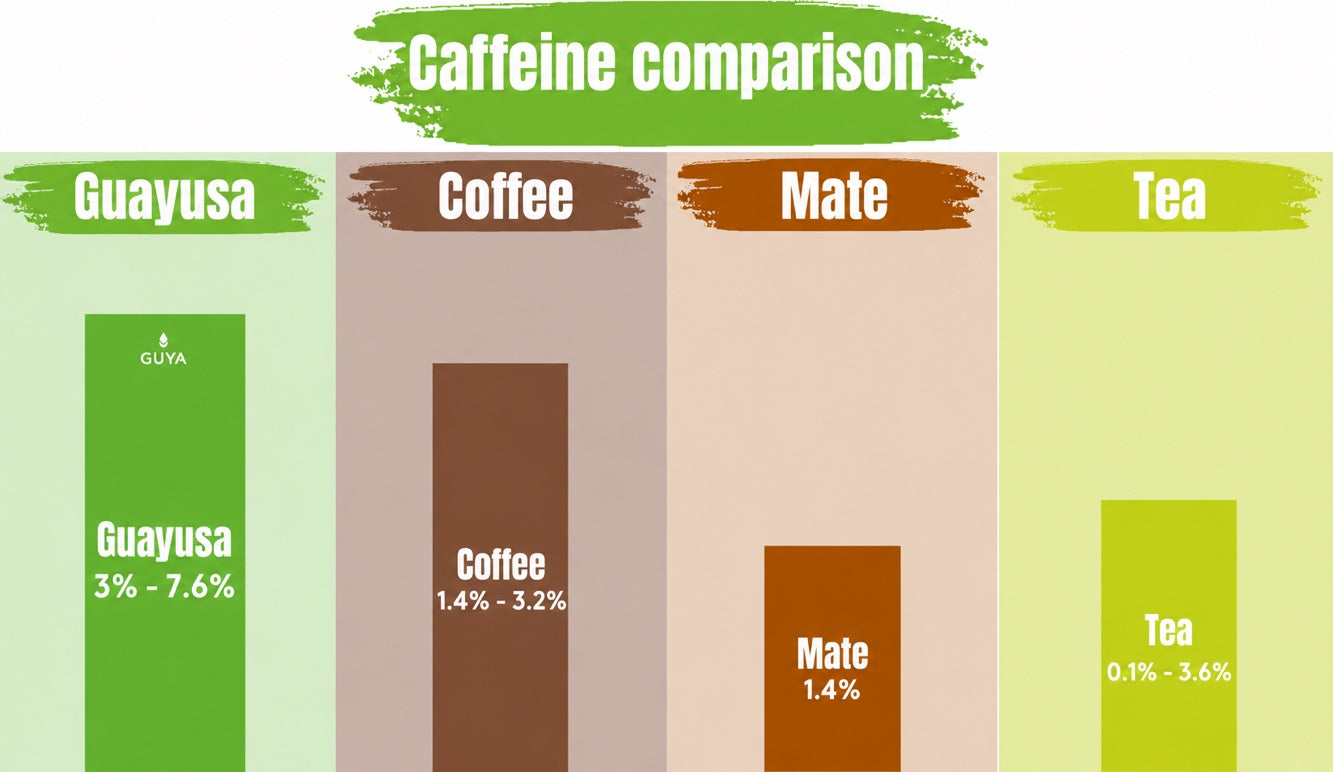
Various tests have found that guayusa has a caffeine content between 1.9% and 7.6%, averaging around 3.0%.
Guayusa’s caffeine content depends greatly on quality. It is therefore important to make sure that the guayusa you buy has not been dried over a fire or at excessively high temperatures.
Guayusa’s high caffeine content produces a gradual, even effect that lasts for several hours. This is due to the combined action of naturally occurring active compounds such as theophylline, theobromine and L-theanine and a high level of antioxidants. Read our detailed article about the effects of guayusa tea here.
So, how much caffeine does guayusa have? Guayusa, with up to 7.6% caffeine, is the most caffeinated drink in the world. Its unique combination of the active compounds mentioned above also makes it much better suited as an energy booster than coffee, mate or guarana. Guayusa is not bitter and can therefore be prepared easily and in many different ways. Find out more about how to prepare guayusa tea here.
4. How much caffeine does coffee contain
Coffee generally also has a high caffeine content. The exact amount depends in particular on the roast and variety. Arabica coffee contains only around 1.4% caffeine. Robusta, at 2.8%–3.2%, is closer to guayusa’s caffeine content.
However, the natural polyphenols in coffee are destroyed during roasting. As a result, unlike the caffeine in guayusa, coffee caffeine is unbound and reaches the stomach more quickly.
Many people therefore describe coffee’s effects as unpleasant, with a racing heart, stomach problems and jitters.
5. Yerba mate tea caffeine content vs guayusa caffeine content
How much caffeine is in yerba mate? Yerba mate is also considered a plant with a very high caffeine content. Compared with guayusa, however, mate tea caffeine content is only 1.4%. For a strong effect, a large amount of mate has to be used in a bombilla. Mate’s caffeine is bound to many bitter compounds, yet its effect, like coffee’s, is very sudden.
Mate soft drinks always contain isolated ‘caffeine’ as an additional ingredient. In most cases, no real mate is brewed and processed at all; only mate flavouring or concentrate is used.
6. How much caffeine is in green and black tea?
The word ‘tea’ actually refers to green tea, black tea and all varieties that come from the tea plant (Camellia sinensis). Infusions such as guayusa and mate are therefore not technically teas.
The caffeine content of green or black tea depends on the variety, its cultivation and how it is processed.
An inexpensive green or black tea in bags may contain as little as 0.1% caffeine. A more expensive tencha, by contrast, can contain up to 3.9% caffeine.
As with guayusa, caffeine in tea is bound to natural polyphenols and is therefore buffered. However, the polyphenols are different, so the effect is naturally different too. Steeping time plays a major role in how the polyphenols are released.
By contrast, all the caffeine is released after 5 to 15 minutes. Find out more about green tea steeping times in our article: ‘Green tea steeping time – how long should green tea steep?’.
There is therefore no single answer to how much caffeine green or black tea contains: it depends on the growing region, cultivation method and processing.
| Type | Caffeine |
|---|---|
| Guayusa | 3%–7.6% |
| Black tea | 1%–3.5% |
| White tea | 3%–6% |
| Yellow tea | 0.1%–0.4% |
| Green tea | 0.1%–3.9% |
7. Conclusion – how does guayusa’s caffeine content compare?
The caffeine content of guayusa is up to 7.6% – extremely high. Guayusa therefore stands out clearly from average teas and yerba mate. On average, guayusa contains around 3.0% caffeine, while yerba mate tea contains around 1.4%. Mate tea therefore has less caffeine than coffee and sometimes less than tea, which can contain more or less caffeine depending on the variety, but may certainly have more than coffee.
So the idea that coffee is the world’s most caffeinated drink is not true.
Guayusa has more caffeine than coffee, tea and mate tea. Guayusa also contains natural polyphenols, which are secondary plant compounds, as well as theophylline, theobromine and L-theanine, and twice as many antioxidants as green tea.
Would you like to experience the distinctive effects of guayusa tea for yourself? Visit our online shop to buy our guayusa tea! Completely natural, with no additives and from purely organic cultivation. Give it a try!